

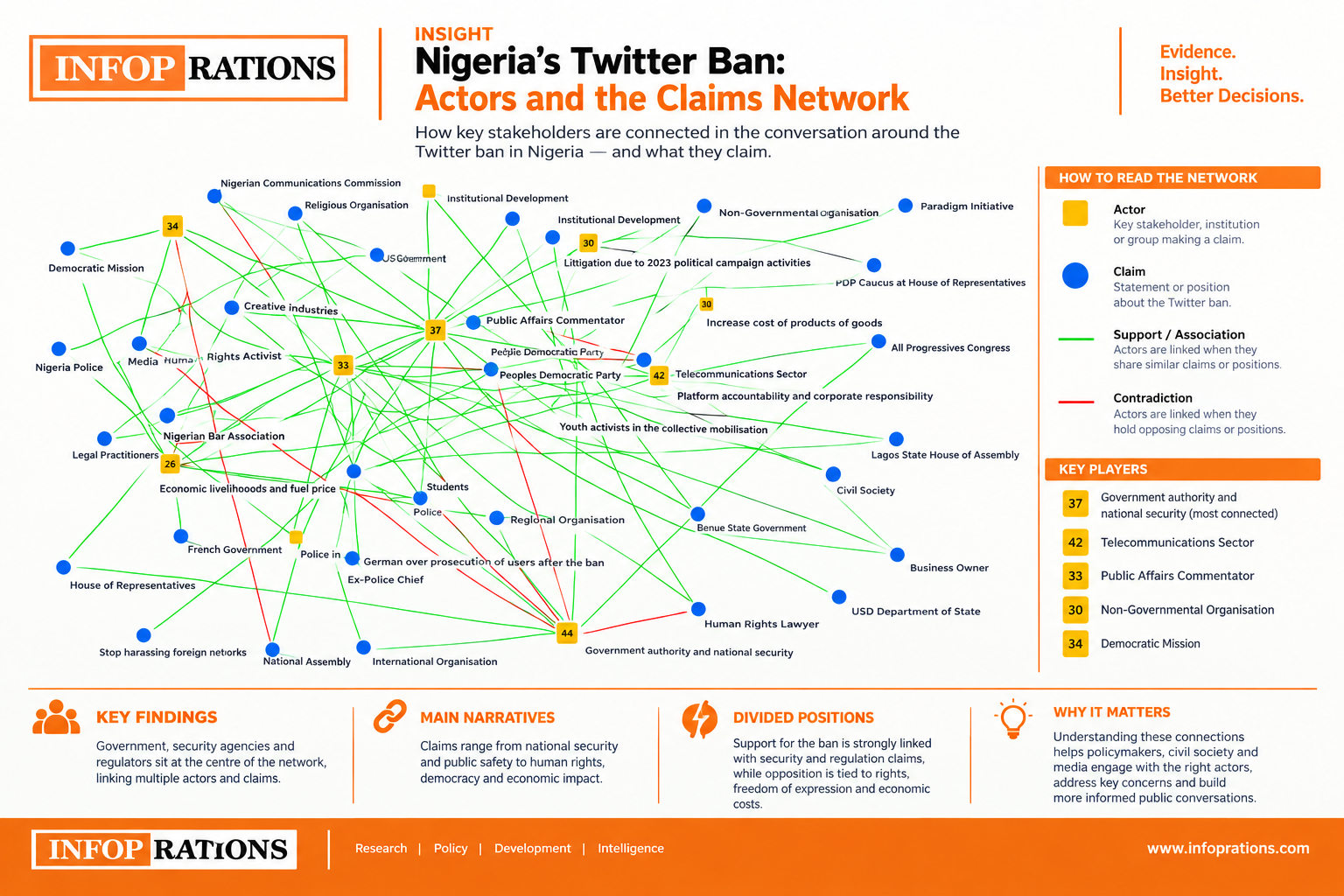
Digital platforms have become important spaces for political debate, economic activity, public engagement and the exchange of information. For governments, they present a difficult responsibility: protecting national interests while preserving the freedoms, opportunities and public participation that digital communication enables. Nigeria’s Twitter ban brought these competing responsibilities into sharp focus. An examination of how different stakeholders discussed the ban reveals a policy lesson that extends beyond one platform or one government. When decisions affect how citizens communicate, conduct business and participate in public life, the arguments used to justify those decisions matter almost as much as the decisions themselves.
The debate involved government institutions, political parties, civil society organisations, legal professionals, businesses, international organisations and public commentators. Their positions reflected different concerns about national security, freedom of expression, democratic accountability, economic livelihoods, youth mobilisation and the responsibilities of digital platforms. These concerns demonstrate why digital governance cannot be reduced to the question of whether governments possess the authority to regulate technology companies. The more important question is how that authority should be exercised in ways that are necessary, proportionate, transparent and responsive to the public interest.
Governments have legitimate responsibilities to protect national security, maintain public order and ensure that technology companies operate responsibly. Citizens, however, also have legitimate interests in freedom of expression, access to information and the ability to question public decisions. These responsibilities should not automatically be treated as opposing objectives.
National Security, Digital Rights and Economic Interests Must Be Considered Together
The Twitter ban illustrates the importance of considering the wider consequences of digital policy. The debate extended beyond government authority and freedom of expression to questions about economic livelihoods, digital businesses, platform accountability, international relations and collective mobilisation. This matters because digital platforms are not merely spaces for conversation. They support commercial relationships, business visibility, information exchange and opportunities for participation in the digital economy. Restrictions on access to digital services can therefore have implications that extend beyond the immediate regulatory objective.
Policymakers should assess these implications alongside national security and other public interest considerations. Such assessments should consider the potential consequences for entrepreneurs, workers, businesses and citizens who depend on digital communication, while examining whether the intended objectives can be achieved through less restrictive measures. The debate also raises an important question about how governments justify their decisions. When restrictions are introduced, citizens need clear explanations of the problems being addressed, the evidence supporting intervention, the expected outcomes and the safeguards available to protect their rights.
Without credible answers, a decision presented as necessary for national interest can generate broader questions about accountability, proportionality and the limits of state power. The lesson for Nigeria is that digital policy should not be developed in isolation from economic policy, democratic governance and the protection of citizens’ rights.
Disagreement Should Inform Policy, Not Simply Be Dismissed
One of the most important lessons from the debate is the need for government to understand the different arguments surrounding its decisions. Disagreement does not necessarily mean that stakeholders reject government authority or oppose every aspect of a policy. Some stakeholders may accept the need for regulation while questioning its implementation. Others may support greater accountability for technology companies but reject restrictions they consider excessive. Some may focus primarily on the economic consequences, while others emphasise democratic participation and civil liberties. Treating these positions as one collective opposition risks overlooking valuable information that could improve policymaking.
Government institutions should distinguish between disagreement with a policy objective, concerns about the methods used to achieve it and objections to its consequences. These distinctions can help officials determine where further explanations are needed, where implementation requires adjustment and where competing public interests must be reconciled.
Listening does not require government to accept every demand. Rather, it requires officials to understand the concerns being expressed before deciding how to respond.
This approach also has implications for strategic communication. Effective communication should not begin and end with defending government actions. It should involve understanding the questions citizens are asking, identifying unresolved concerns and explaining the evidence behind policy decisions. Public communication becomes more credible when institutions acknowledge legitimate concerns and demonstrate how feedback informs their decisions.
Building a More Responsive Approach to Digital Policy
Nigeria needs a more systematic approach to understanding public debate around digital governance. Government institutions can regularly examine newspaper reports, stakeholder statements, public submissions and other credible sources to identify emerging concerns, competing arguments and potential policy risks.
The objective should not be to suppress disagreement or manufacture public support. It should be to understand competing interests, anticipate unintended consequences and improve the quality of decisions. Such an approach could help policymakers identify concerns before they escalate, assess whether official explanations adequately address public questions and create opportunities for constructive engagement among regulators, businesses, civil society organisations and citizens.
The findings should inform policy reviews, stakeholder consultations and public communication. They should also support the evaluation of digital policies after implementation, allowing government to determine whether its objectives have been achieved and whether unintended consequences require corrective action.
This is particularly important as governments confront questions involving platform accountability, artificial intelligence, online misinformation and the regulation of digital communication. These issues require decisions that are informed by evidence, attentive to citizens’ rights and responsive to changing technological and social conditions.
The Real Test of Digital Governance
Nigeria’s Twitter ban should be understood as more than a historical disagreement between a government and a technology company. It offers a broader lesson about the relationship between public authority, digital rights, economic interests and public trust. Governments must be able to respond to genuine security and regulatory challenges. Equally, they must recognise that the consequences of digital policy extend beyond the immediate problems a decision seeks to address.
The real test of digital governance is not simply whether a government can impose a restriction. It is whether the government can demonstrate that its decision serves the public interest, account for its consequences and maintain public confidence in the process. For Nigeria, making this principle central to digital policymaking would be an important step towards governance that is more informed, accountable and responsive to the realities of a connected society.










Leave a Reply