

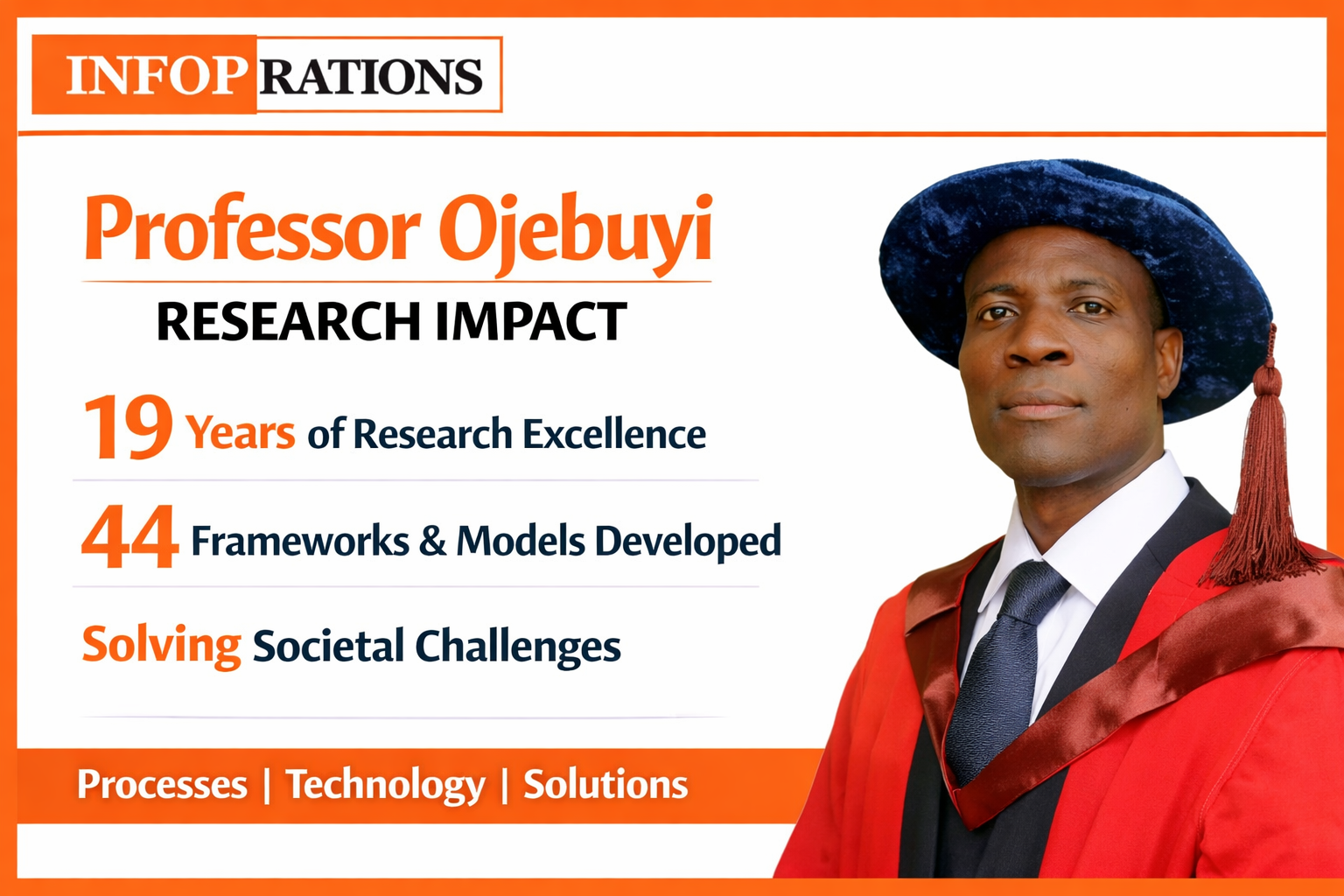
Why do life-changing medical breakthroughs, sophisticated technologies, and well-funded government policies so often fail to achieve their intended impact? The answer, according to 19 years of research by Professor Babatunde Raphael Ojebuyi, lies not in a lack of resources but in a “culture of silence” and a failure to recognise communication as institutional infrastructure.
Since 2007, Professor Ojebuyi’s work has evolved into what can be termed the Research Impact Playbook—a strategic shift from treating communication as a descriptive academic exercise to employing it as actionable intelligence for solving complex societal problems. Through the lens of Infoprations’ Impact Discovery Tool (IDT), his body of over 80 publications reveals a blueprint of 44 frameworks and models designed to guide immediate stakeholder action and forecast future societal needs across five key components: people, process, product/service, technology, and finance.
The Playbook Strategy: From Description to Action
Traditional scholarship often remains trapped in silos, detached from the needs of policymakers. Professor Ojebuyi’s playbook intentionally breaks this cycle by advancing an evidence-to-policy communication framework. This approach reframes academic inquiry as a problem-solving mechanism, ensuring that research findings (on everything from media ethics to genomic trust) are translated into practical guidance for governments and businesses.

Pillar 1: Breaking the Silence to Save Lives (People)
A core tenet of the playbook is that many social problems begin with silence. In the realm of public health, Ojebuyi identifies silence—not just a lack of clinics—as the primary barrier to progress. His Communication-Based Family Health Intervention Model reframes dialogue between parents and children about reproductive health as a vital public health intervention rather than a private family matter. Similarly, his Communication-Driven Reproductive Health Model proves that spousal communication is a more effective predictor of contraceptive adoption than medical access alone. By humanising vulnerable groups through an Empathy-Oriented Communication Intervention Framework, he demonstrates that stories, not just facts, are the tools needed to dismantle the stigma surrounding health conditions like HIV/AIDS.
Pillar 2: Strengthening the Pillars of Governance (Process)
In the “Process” component, the playbook insists that democratic legitimacy depends on communication integrity. Professor Ojebuyi challenges the “secondary gatekeeping” in newsrooms where editorial choices distort public understanding. To combat this, his Information Quality Control Framework provides media organisations with mechanisms for transparency and verification, while his Communication Accountability Framework for Democracy advocates for neutral reporting and independent monitoring to maintain public trust in electoral systems.
Pillar 3: Humanising Innovation (Technology & Product)
Perhaps the most striking insight of the playbook is that technology does not automatically improve lives. Whether it is an ICT system or a new medical procedure, success depends on whether people trust and understand the innovation. Ojebuyi’s Human-Centred Technology Adoption Model cautions against an obsession with hardware, arguing that digital transformation fails when it overlooks human adaptation and communication competence. For scientific breakthroughs to succeed, he proposes a Science Communication for Service Accessibility Framework, which translates complex jargon into culturally grounded, accessible language that turns public “hesitation” into “participation”.
Pillar 4: Communication as an Engine of Prosperity (Finance)
Finally, the playbook reframes economic challenges, such as youth unemployment and rural poverty, as communication failures. Many employment initiatives fail because of a “disconnect” between institutional assumptions and the actual aspirations of the youth. By integrating the Employment Communication Framework, policymakers can move from top-down directives to participatory designs that align opportunities with reality. In agriculture, his research reframes the mobile phone not as a gadget, but as a productivity tool that enables rural farmers to break their isolation and access market intelligence.
Professor Babatunde Ojebuyi’s 19-year legacy offers a compelling conclusion. Communication isn’t an accessory to service delivery; it is an integral part of the service itself. For leaders in government, technology, and health, the message is clear. To build resilient institutions and prosperous communities, we must stop viewing communication as a one-way information channel and start treating it as the foundational infrastructure upon which all societal progress is built. In a world of fractured trust, those who follow this playbook (using clarity, empathy, and ethical engagement) are the ones who will successfully navigate the complexities of the future










Leave a Reply