


Nigeria’s oil sector has long been shaped by a complex web of laws, institutions, and financial mechanisms. The recent executive order issued by Bola Ahmed Tinubu represents a significant attempt to reshape that system by redirecting oil revenues back to the Federation Account and reducing the number of deductions currently allowed under the legal framework established by the Petroleum Industry Act.
The directive seeks to restore what the Federal Government considers the constitutional revenue rights of the three tiers of government. The order is anchored on Section 44(3) of the Nigerian Constitution, which vests ownership and control of all petroleum resources in the Government of the Federation. By invoking this constitutional authority, the presidency has moved to restructure how oil revenues are collected, managed, and distributed. The decision highlights an enduring tension in Nigeria’s petroleum governance: who controls the flow of oil revenues and how those revenues should be allocated.
The struggle over oil revenue control
The PIA was enacted in 2021 to reform Nigeria’s petroleum sector after years of debate. One of its central reforms was the transformation of the national oil company into a commercial entity, now known as NNPC Limited. The law also introduced several funds designed to finance exploration, infrastructure development, and environmental remediation.
However, the accumulation of these funds and deductions has produced an unintended outcome. According to the Federal Government, multiple charges embedded within the law have reduced the amount of revenue that ultimately reaches the Federation Account. Under the existing framework, NNPC Limited retains 30 percent of oil and gas profits from certain contractual arrangements as a management fee. It also retains 20 percent of its profits to support working capital and future investments. In addition, another 30 percent of profit oil and profit gas is allocated to the Frontier Exploration Fund, which is intended to finance exploration in new areas of the country.
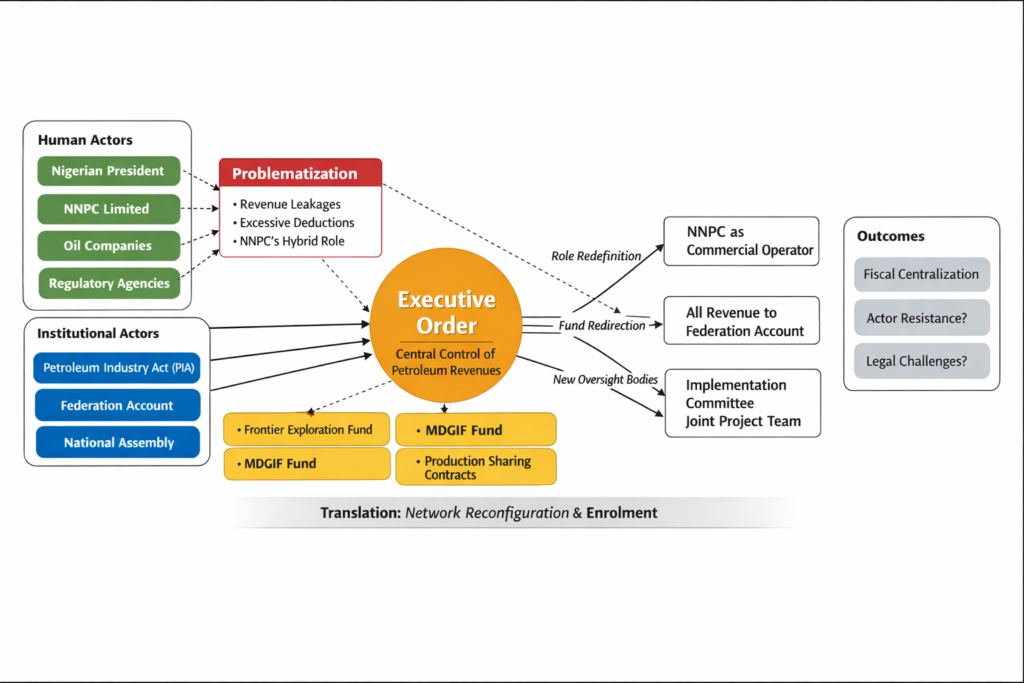
From the government’s perspective, these layers of deductions have created a system in which substantial revenues are retained within institutional structures rather than transferred to the national treasury. The executive order attempts to reverse this trend by eliminating what it describes as duplicative or excessive deductions.
Repositioning the national oil company
A central feature of the directive is the effort to redefine the role of NNPC Limited within the petroleum sector. The company has historically played several roles at once. It has acted as a commercial participant in oil projects while also exercising significant influence over operational costs and financial arrangements within production sharing contracts. This dual role has raised concerns about transparency and competitive neutrality.
The executive order attempts to address this concern by narrowing the company’s financial control over certain revenue streams. NNPC Limited will no longer manage the 30 percent Frontier Exploration Fund and will cease collecting the 30 percent management fee on profit oil and profit gas. These revenues will now be transferred directly to the Federation Account. By making this change, the presidency seeks to accelerate the transition of NNPC Limited into a purely commercial operator rather than a hybrid institution that combines commercial and fiscal functions.
Redirecting financial flows
The order also introduces a new structure for revenue payments. Oil and gas contractors operating under production sharing arrangements must now pay royalty oil, tax oil, profit oil, and related government interests directly to the Federation Account.
In addition, the directive suspends payments of gas flare penalties into the Midstream and Downstream Gas Infrastructure Fund. These penalties will instead be paid directly into the national treasury. These measures aim to simplify the financial architecture of Nigeria’s petroleum sector. The government believes that reducing intermediary deductions will improve transparency and increase the funds available for national priorities such as infrastructure, security, healthcare, and energy transition investments.
Institutional coordination and oversight
To implement the reforms, the presidency has established an implementation committee composed of key economic and legal officials. The committee will coordinate the transition and ensure that relevant agencies comply with the new arrangements. This step acknowledges an important reality of policy reform in Nigeria. Major changes in the oil sector often require coordination among multiple institutions with overlapping mandates. Without careful management, institutional friction can undermine policy objectives.
The broader implications
The executive order represents more than a technical adjustment to petroleum accounting rules. It signals a broader effort by the presidency to reassert fiscal control over the oil sector at a time when government revenues face increasing pressure.
Nigeria’s public finances remain heavily dependent on oil income, even as production levels fluctuate and global energy markets evolve. Ensuring that a larger share of petroleum revenues reaches the national treasury is therefore seen as essential for economic stability. Yet the success of the reform will depend on how effectively the government manages the transition. Institutions that previously controlled these funds may resist changes to their authority, while industry participants will look for clarity on how the new payment structure affects contractual obligations.
In the coming months, the interaction between the executive order and the provisions of the Petroleum Industry Act will shape the future of Nigeria’s petroleum governance. What is clear, however, is that the debate over who controls the nation’s oil revenues is far from settled.










Leave a Reply