


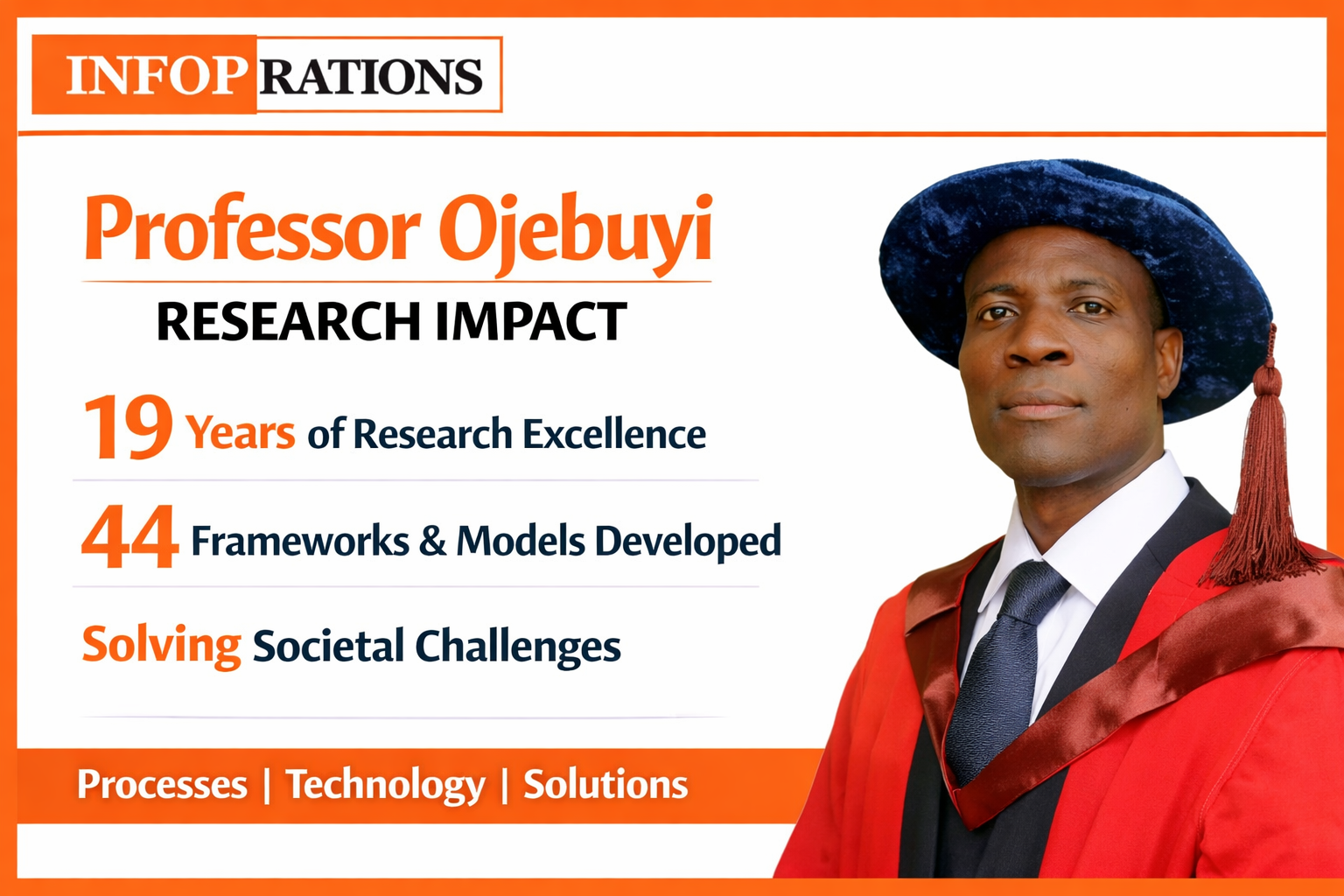
In the traditional halls of academia, career progression is often viewed as a linear, gruelling climb up rigid hierarchical rungs. However, Professor Ayobami Ojebode’s career at the University of Ibadan offers a “radically simple” alternative that challenges the status quo. By rising to the rank of Professor in 2013 without ever serving as an Associate Professor, Ojebode demonstrated that academic success is not merely a product of longevity, but of a strategic, integrated approach to scholarship. This approach, known as the Hybrid-Concentric Model (HCM), provides a blueprint for a sustainable and impactful academic career, particularly within the fields of media, journalism, and communication.
The Power of Integration: The Hybrid-Concentric Model
At the heart of this success is the refusal to view teaching, research, mentoring, and community service as competing silos. Instead, the HCM situates a scholar’s energy at “the place where four footpaths meet”. For Ojebode, these paths are intra- and inter-connected, creating a self-sustaining cycle of productivity.
When teaching is “solution-driven,” it ceases to be a chore and becomes a laboratory for identifying talent. For instance, Ojebode’s introductory reading classes for 100-level students utilised weekly summary exercises to build a “bundle of skills” applicable across all communication branches. This method does more than educate; it identifies “change makers” early in their journey. When research is “biologically driven” by a passion for one’s culture—as seen in Ojebode’s focus on indigenous and development communication—the work remains vibrant and personally meaningful.
The Publication Playbook: Velocity with Purpose
One of the most striking aspects of Ojebode’s career is his “publication prowess”. Between 2008 and 2013, he engaged in an “aggressive publication pursuit,” producing 35 publications in just five years. This is not merely a feat of volume but a strategic masterclass in academic output.
For the modern scholar in media and journalism, this “Publication Playbook” suggests that rapid advancement is possible when research is tied directly to real-world application. Two of his works, Doing Community Radio and Audience Research for Campus Radio Stations, have been adopted as training manuals across Nigeria and beyond. By focusing on “muted voices” and the peculiarities of the Nigerian socio-political landscape, Ojebode ensured his research remained relevant to both peer-reviewed journals and international policy bodies like the World Bank and DFID.
Strategic Collaboration: The Mentorship Ladder
Perhaps the most vital lesson for upcoming scholars is the role of collaborative work ethics. Analysis of Ojebode’s 63 publications reveals that over 60% were co-authored. This was not a pursuit of convenience, but a deliberate “collaboration ladder”.
Ojebode’s philosophy on authorship is a model for ethical leadership: “Whoever is first to bring up an idea ended up being the first author. Well, sometimes, I cede that right to help make the junior person also visible”. This transparency and willingness to elevate others is why his leadership at the Department of Communication and Language Arts resulted in 41 PhD graduates and 13 First Class undergraduate degrees during his tenure.
In the HCM, mentorship is not an adjunct to research—it is the engine of it. By collaborating with students and colleagues, a senior scholar can multiply their output while simultaneously “spurring upcoming ones into unexpected greatness”.
Applied Research as a Catalyst for Change
Thought leadership in academia requires moving beyond the “ivory tower” to engage with the users of research outputs. Ojebode’s 21 years of teaching have been marked by a profound interest in shaping political, economic, and social landscapes through applied research. His investigations into development, environmental, and social issues have translated into keynote speeches and policy dialogues that address what he cannot capture within publications alone.
For researchers in communication, this means situating your work within the specific “peculiarities” of your context—whether political, economic, or environmental. By doing so, you create a career that is not only “result-oriented” but deeply committed to the service of humanity.
A New Standard for the Change Maker
The career of Professor Ayobami Ojebode proves that academic sustainability is achieved through integration, not isolation. The Hybrid-Concentric Model offers a roadmap for the modern scholar to achieve rapid publication goals without sacrificing the quality of teaching or the depth of mentorship.
By adopting an aggressive yet collaborative publication strategy and grounding research in the needs of the community, we can produce the “change makers” our society desperately needs. As we look to the future of global scholarship, the lesson is clear: the most successful leaders are those who build ladders for others to climb.








Leave a Reply